Multi-Agent Orchestration — Google ADK + Temporal
Last updated Oct 21, 2026
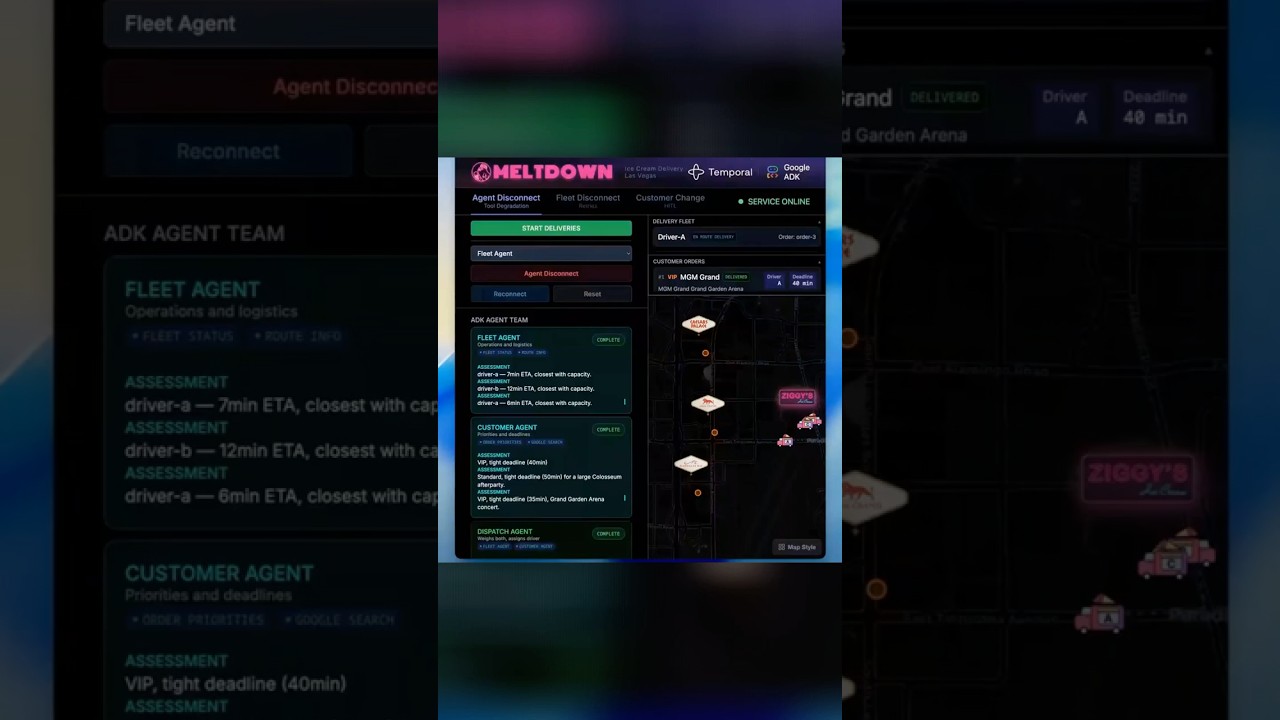
This recipe builds a multi-agent dispatch pipeline using Google ADK and the Google ADK integration for Temporal. Two agents reason in parallel, a third synthesizes their output and submits a structured decision — and every LLM call and every I/O tool call is a durable Temporal Activity. (The final decision write is a plain in-workflow tool — see Structured output via session state.)
ADK ↔ Temporal mapping
| ADK concept | Temporal mapping |
|---|---|
| Orchestrator agent | Pure Python inside the workflow (Runner.run_async) |
LLM call (BaseLlm) | invoke_model activity (via TemporalModel) |
Tool call (@activity) | A named activity (via activity_tool) |
| Session state | Read back from the in-memory SessionService after the run |
| Agent reasoning | Lives in the workflow; durable, replayable |
| Anything that does I/O | Lives in an activity; retried, timed out, observed |
Pipeline
                      ┌──────────────┐
                      │ Order input  │
                      └──────┬───────┘
                             │
            ┌────────────────┴────────────────┐
            │       ParallelAgent             │
            │ ┌─────────────┐ ┌─────────────┐ │
            │ │ Fleet Agent │ │ Customer    │ │
            │ │             │ │ Agent       │ │
            │ └─────────────┘ └─────────────┘ │
            └────────────────┬────────────────┘
                             │
                      ┌──────▼───────┐
                      │ Dispatch     │
                      │ Agent        │
                      └──────┬───────┘
                             │
                  tool_submit_assignment
                             │
                      ┌──────▼───────┐
                      │ Workflow     │
                      │ returns      │
                      │ AssignmentOut│
                      └──────────────┘
- Fleet Agent — checks driver positions, capacity, ETAs.
- Customer Agent — checks order priority, deadline, urgency. (Runs in parallel with Fleet Agent.)
- Dispatch Agent — reads both assessments from session state, picks a
driver, submits the structured decision via
tool_submit_assignment.
This recipe highlights:
- Multi-agent composition with ADK —
ParallelAgent+SequentialAgentdriven by a singleRunnerinvocation. - LLM-as-activity —
TemporalModelroutes every LLM call through aninvoke_modelactivity. Each call appears as a separate event in workflow history with retries, timeouts, and a Temporal-UI summary. - Tool-as-activity —
activity_toolwraps a Temporal Activity so the agent can call it. Each of these tool invocations is its own activity event. (The Dispatch agent's finaltool_submit_assignmentcall is a plain in-workflow tool, not an activity — it only writes to local session state.) - Structured output via session state — the final agent calls a Python
tool that writes to
tool_context.state. The workflow reads that key back after the runner completes. - Sandbox-safe ADK imports — ADK and
google.genaiare imported underworkflow.unsafe.imports_passed_through()so the workflow sandbox does not reject them.
Prerequisites
- Python 3.10 to 3.13
uvfor dependency management- A running Temporal Dev Server (
temporal server start-dev) - A Google API key with access to Gemini (
GOOGLE_API_KEY)
Setup
uv sync
export GOOGLE_API_KEY='your-api-key-here'
Run the recipe
In one terminal, start the Temporal Dev Server:
temporal server start-dev
In a second terminal, start the worker:
uv run python worker.py
In a third terminal, kick off an assignment:
uv run python start_workflow.py
You should see a final assignment printed, e.g.:
Assigned driver: driver-a
Reasoning:       Closest available driver with capacity for VIP order
Open the Temporal UI at http://localhost:8233 to see each LLM call and tool call recorded as its own activity in the workflow history.
Connect to Temporal Cloud
This recipe connects to Temporal using environment configuration. With nothing configured, it connects to a local Temporal Service at localhost:7233.
To run it against Temporal Cloud, save your connection details as a profile with the Temporal CLI:
temporal config set --profile cloud --prop address --value "<your Temporal Cloud endpoint>"
temporal config set --profile cloud --prop namespace --value "<your Namespace>"
temporal config set --profile cloud --prop api_key --value "<your API key>"
Select the profile in each terminal you use for the recipe, and check that it connects:
export TEMPORAL_PROFILE=cloud
temporal workflow count
To authenticate with mTLS certificates instead of an API key, see environment configuration.
Architecture
multi_agent_adk_python/
├── activities/
│   └── tools.py             # @activity.defn — fleet status, priorities, route info
├── models/
│   └── models.py            # AssignmentInput / AssignmentOutput (pydantic)
├── workflows/
│   ├── assignment_workflow.py  # agents + workflow inline
│   └── _activity_tool.py       # ADK ↔ Temporal tool adapter
├── worker.py
├── start_workflow.py
└── tests/
    ├── test_activities.py
    └── test_workflow.py        # workflow logic with a mocked invoke_model
Activities as agent tools
Each tool the agents can call is a Temporal Activity:
File: activities/tools.py
async def tool_get_fleet_status() -> str:
    """Return current fleet state: driver positions, capacity, and status."""
    return (
        "Fleet status:\n"
        "- driver-a: pos=(36.1147, -115.1728)  capacity=2/3  status=AVAILABLE\n"
        "- driver-b: pos=(36.1099, -115.1750)  capacity=0/3  status=AVAILABLE\n"
        "- driver-c: pos=(36.1162, -115.1745)  capacity=3/3  status=FULL\n"
        "- driver-d: pos=(36.1213, -115.1700)  capacity=1/3  status=AVAILABLE\n"
        "- driver-e: pos=(36.1080, -115.1760)  capacity=2/3  status=DISCONNECTED"
    )
In a real system the body would query a fleet database or hit an internal service. Here we return canned strings so the recipe runs without any backing infrastructure.
TemporalModel — every LLM call is an activity
TemporalModel (from
temporalio.contrib.google_adk_agents) is an ADK BaseLlm whose
generate_content_async runs through a Temporal Activity. The plugin
registers that activity (invoke_model) on your worker for you.
File: workflows/assignment_workflow.py
def _fleet_agent() -> Agent:
    return Agent(
        name="fleet_agent",
        model=TemporalModel(
            DEFAULT_MODEL,
            activity_config=ActivityConfig(
                task_queue=TASK_QUEUE,
                summary="Fleet Agent — LLM reasoning",
            ),
        ),
        ...
        tools=[_fleet_status_tool, _route_info_tool],
        output_key="fleet_assessment",
    )
activity_tool — every tool call is an activity
activity_tool wraps a @activity.defn so it presents to ADK as a regular
Python tool, but the call body executes via workflow.execute_activity:
File: workflows/assignment_workflow.py
_fleet_status_tool = activity_tool(
    tool_get_fleet_status,
    task_queue=TASK_QUEUE,
    summary="Fleet Agent — get fleet status",
    start_to_close_timeout=timedelta(seconds=10),
    retry_policy=_TOOL_RETRY,
)
The local workflows/_activity_tool.py adds graceful failure on top of the
upstream temporalio.contrib.google_adk_agents.workflow.activity_tool:
when an activity execution fails (retry policy exhausted, non-retryable
application error, timeout), the wrapper catches the ActivityError
and returns it to the LLM as a string so the agent can adapt instead of
crashing the pipeline. (The retry attempts still appear in workflow
history.) Programming bugs — e.g. argument-binding errors — are not
caught and propagate normally. Upstream activity_tool (temporalio>=1.25)
already handles multi-arg activities and local non-workflow ADK runs.
Compose the pipeline
File: workflows/assignment_workflow.py
def build_assignment_pipeline() -> SequentialAgent:
    """Compose the full pipeline: Parallel(Fleet, Customer) → Dispatch."""
    return SequentialAgent(
        name="order_assignment",
        sub_agents=[
            ParallelAgent(
                name="assessment_parallel",
                sub_agents=[_fleet_agent(), _customer_agent()],
            ),
            _dispatch_agent(),
        ],
    )
Fleet and Customer agents run concurrently inside ParallelAgent. When
both finish, the Dispatch agent runs. Each sub-agent's output_key
(fleet_assessment, customer_assessment) writes its final response into
session state — that's how the Dispatch agent gets the upstream context
without passing it explicitly.
Structured output via session state
The final agent calls a plain Python tool (not a Temporal activity) that writes the decision into ADK session state:
File: workflows/assignment_workflow.py
async def tool_submit_assignment(
    tool_context: ToolContext,
    driver_id: str,
    reasoning_summary: str,
) -> str:
    """Submit the final order assignment. You MUST call this tool with your decision.

    Args:
        driver_id: The driver to assign the order to (e.g. "driver-a").
        reasoning_summary: One-sentence explanation of the choice.
    """
    tool_context.state["assignment"] = {
        "driver_id": driver_id,
        "reasoning_summary": reasoning_summary,
    }
    return "Assignment submitted."
The workflow runs the pipeline to exhaustion, then reads that key back:
File: workflows/assignment_workflow.py
async for _ in runner.run_async(
    user_id="workflow",
    session_id=session.id,
    new_message=Content(parts=[Part(text=prompt)]),
):
    pass

updated = await session_service.get_session(
    app_name=APP_NAME,
    user_id="workflow",
    session_id=session.id,
)
state = (updated.state if updated else None) or {}
assignment = state.get("assignment") or {}

return AssignmentOutput(
    driver_id=assignment.get("driver_id", ""),
    reasoning_summary=assignment.get(
        "reasoning_summary", "Dispatch agent did not submit a decision."
    ),
)
This pattern — a tool call that writes structured output into session state — is how you reliably extract a typed decision from a multi-agent pipeline that emits many intermediate events.
Sandbox-safe ADK imports
ADK and google.genai aren't safe under Temporal's workflow sandbox by
default, so they're imported under
workflow.unsafe.imports_passed_through():
File: workflows/assignment_workflow.py
with workflow.unsafe.imports_passed_through():
    from google.adk.agents import Agent, ParallelAgent, SequentialAgent
    from google.adk.runners import Runner
    from google.adk.sessions import InMemorySessionService
    from google.adk.tools import ToolContext
    from google.genai.types import Content, Part
    from temporalio.contrib.google_adk_agents import TemporalModel
The GoogleAdkPlugin registered on the worker handles the rest of the
sandbox passthroughs and deterministic-runtime overrides ADK needs (UUIDs,
clocks).
Worker — one queue, one plugin
File: worker.py
config = ClientConfig.load_client_connect_config()
config.setdefault("target_host", "localhost:7233")
client = await Client.connect(
    **config,
    data_converter=pydantic_data_converter,
)

# GoogleAdkPlugin registers the `invoke_model` activity (used by
# TemporalModel for LLM calls) and provides the workflow-sandbox
# passthroughs and deterministic runtime overrides ADK needs.
worker = Worker(
    client,
    task_queue=TASK_QUEUE,
    workflows=[MultiAgentAssignmentWorkflow],
    activities=[
        tool_get_fleet_status,
        tool_get_order_priorities,
        tool_get_route_info,
    ],
    plugins=[GoogleAdkPlugin()],
)

await worker.run()
GoogleAdkPlugin registers the invoke_model activity that
TemporalModel routes LLM calls to — you don't need to register it
yourself.
Extensions
This pipeline is the minimal multi-agent shape. Natural ways to extend it:
- Real backing services — replace the canned tool bodies with real database queries, route APIs, or internal microservices.
- More parallel branches — add agents to the
ParallelAgent(an inventory agent, a credit-check agent, a fraud-screen agent) — each posts its assessment viaoutput_keyfor the synthesizer to read. - Multiple sequential stages — add a validation or post-processing
stage after Dispatch by extending the outer
SequentialAgent. - Human-in-the-loop on the synthesizer — pause before the final
decision via a Temporal Signal. See the
human_in_the_loop_pythonrecipe. - Graceful degradation — fail-fast retry policies on a sub-agent's tools so the synthesizer can decide with partial data when an upstream service is unavailable.